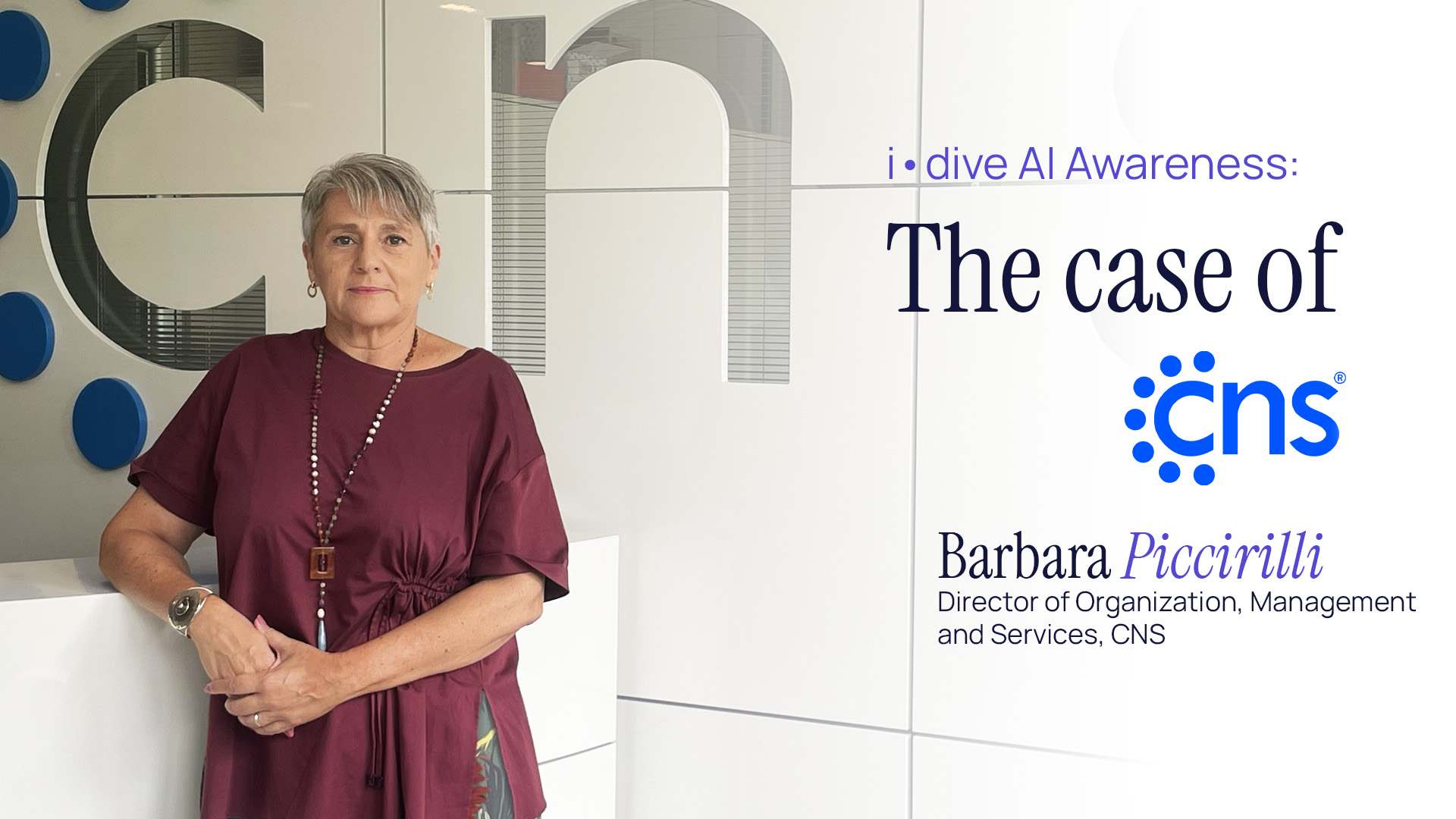
CNS (Consorzio Nazionale Servizi) is a cooperative consortium specialising in integrated services and facility management. Rooted in the cooperative sector, it shares its core values: respect for people, dignity of work, legality, transparency and economic, social and environmental sustainability. To make AI useful and integrated into daily activities, CNS partnered with Gruppo Pragma on an i•dive AI Awareness journey. The project was built around the needs of three teams already working together every day on the same processes and goals.
CNS’s need: making AI a shared capability, starting with processes
CNS aimed to make AI part of its organisational culture: not a topic reserved for specialists, but an accessible, shared capability.
Listening to the three teams’ needs to design tailored learning shifted the focus from general awareness to practical application. Rather than merely understanding what AI can do, participants learned to use it in real tasks and workflows and identify the most relevant efficiency opportunities for each group.
The initial assessment identified common barriers across the three teams:
- Difficulty knowing when to trust an AI-generated output and when to verify it;
- A tendency to abandon the tool after an unsatisfactory first result, believing it would be quicker to do the task independently;
- Uncertainty about compliance and which data may be shared with AI tools.
Such barriers are common in organisations and rarely stem from a lack of technical skills; they mainly reflect a lack of shared criteria for when and how to use AI. Recognising them early made it possible to build the programme around real situations.
The i•dive solution
Gruppo Pragma designed a journey to support AI adoption in work processes, starting with teams and gradually contributing to a broader AI culture.
Three teams followed three distinct programmes built on a common methodology. Principles and approach remained consistent, while content, practical cases, tools and deeper exploration were adapted to each team’s needs.
As with every i•dive AI Awareness programme, the project combined AI knowledge with the power skills required for conscious use.
Topics covered
On the technical side, the journey focused on the tool already adopted by the company, applying it to everyday tasks in Excel, Word, Outlook and Calendar.
Using existing applications rather than demo environments enabled participants to apply learning directly to current work.
All participants also received an overview of market tools, free solutions and precautions for confidential information or sensitive data.
On adoption, the focus was on barriers to AI use:
- Assessing the reliability of outputs;
- Recognising personal biases and biases in generated answers;
- Learning to correct and refine interactions with the tool;
- Understanding which tasks can be entrusted to AI and which still require direct oversight;
- Using AI not only as a personal assistant but as a shared team resource.
The trust built within the groups was also essential.
A non-judgemental atmosphere encouraged open discussions and helped participants recognise AI’s value for individual activities and shared processes.
Programme structure: three teams, three tailored interventions
The project involved three teams, each following a programme tailored to its needs.
Each group attended six two-hour sessions every fortnight, totalling 36 hours across the three groups. Sessions combined AI learning, power-skill development and exercises applied to everyday processes and tools.
The journey opened and closed with in-person events for all participants. Throughout the project, the i•dive platform offered open access to content, materials, recordings and discussion spaces, maintaining engagement between sessions.
The journey, step by step
- Team needs assessment: mapping barriers and processes to inform each programme.
- In-person kick-off: initial meeting with all three groups to introduce the project and align goals.
- Dedicated team sessions: six two-hour meetings per group, progressively tailored to emerging needs and focused on daily AI applications.
- Digital tools and content: practical templates and resources on i•dive, guided by coaches.
- Workgroups and continuous exchange: after each session, participants could access summaries, slides and recordings and share questions, experiments and discoveries. The space gradually became an internal AI community blog.
- Wrap-up and final survey: an in-person event to share learning, followed by a survey on confidence, critical thinking and possible workplace applications.
Results
AI was introduced at CNS alongside the start of the programme to teach team members how to use it in daily work.
Results are not a before-and-after comparison of actual usage frequency; they come from the final survey and reflect participants’ perceptions of confidence, critical thinking and potential professional applications.
In this sample:
- 89% reported greater confidence using AI.
- 74% felt able to critically assess AI-generated outputs.
- 89% could identify at least one practical application of AI in their work.
Asked to describe the experience in one word, “enriching” was most frequent, alongside exciting, stimulating, enlightening, educational, interesting, useful, autonomy and future.
Beyond the survey percentages, small everyday actions best illustrate participants’ progress.
From “I don’t know whether I can upload this” to “I know what I can upload”. People initially unsure which data could be shared with AI finished with clear criteria for independent decisions, without seeking confirmation from colleagues or managers. For an organisation handling tenders and contracts, this makes the difference between using AI fearfully and confidently.
An inbox that sorts itself. Someone receiving recurring emails from regular senders proposed a simple automation to forward them to the appropriate colleague, benefiting the whole team and speeding up handling.
A picture instead of a thousand words. People explaining complex steps began using AI to turn them into simple visuals for colleagues, saving time and making previously unclear concepts easier to understand.
Three small changes, made by different participants, united by practical tools they could use every day.
89%
has seen their confidence in AI grow.
The majority of participants said they felt more confident using artificial intelligence than they did at the start of the programme.
The voice of Consorzio Nazionale Servizi
CNS’s perspective on i•dive AI Awareness: starting with teams, the value of personalisation and AI’s integration into real workflows.
“The AI Awareness journey represented a genuine shift in perspective for CNS: not only spreading a new culture, but creating an experience that generated ideas, reflections and solutions immediately applicable to daily work, directly affecting processes and people.
The training made AI understandable, practical and usable, encouraging new ways of working and a more mindful approach to innovation.”
Ask a member of the team for advice
If you want to integrate personal development into your workplace, let’s start with a conversation. Tell us who you are, where you are right now, and where you want to go: together, we’ll build a coaching program tailored to your organization.